
Event Types
NewsAbout event
Upskilling the Future of Agriculture
ERASMUS+ AgriFood4Future project is helping the agri-food sector move toward a more digital, low-carbon, and sustainable future by combining capacity building, technical assistance, and practical training for farmers, SMEs, advisors, and other agrifood stakeholders. This mission is highly relevant for the project countries—Spain, Portugal, France, Italy, Greece, and Belgium—while also attracting participants from beyond Europe, reflecting the global demand for stronger innovative skills in agri-food systems.
The context for this transition is clear: digital agriculture is expanding fastest in regions with stronger infrastructure, higher investment capacity, and more consolidated farm structures, while adoption remains lower in many low- and middle-income countries. Across advanced agri-food systems, the most used technologies include IoT sensors, GPS-guided machinery, drones, artificial intelligence, data analytics, smart irrigation, robotics, and decision-support platforms. In more mature markets, these tools are already supporting precision input management, traceability, yield forecasting, and automation; in less advanced settings, adoption often remains limited to basic mobile advisory services or pilot-scale experiments.
The gains from this transition can be substantial. International evidence suggests that precision and digital farming can increase yields by around 5% to 20% in many crops, while reducing fertilizer use by roughly 10% to 30%, pesticide use by about 10% to 25%, and water use by around 15% to 30%, depending on the crop, climate, and technology package used.[1][2] In economic terms, these improvements can translate into lower input costs, better labor efficiency, and stronger profitability, especially where input prices are high and production margins are tight.[3][4]
The effects are also visible at the systems level. Digital tools can reduce waste, improve timing of operations, and lower greenhouse gas emissions through better nutrient management, optimized irrigation, and reduced fuel use. Smart agriculture is therefore not only a productivity strategy, but also a decarbonization strategy: it helps farms produce more with fewer resources, while improving resilience to drought, heat stress, and other climate pressures. In countries with lower digital adoption, the opportunity cost is significant, because farmers may miss these gains due to limited connectivity, high upfront costs, fragmented advisory systems, and weaker digital literacy.
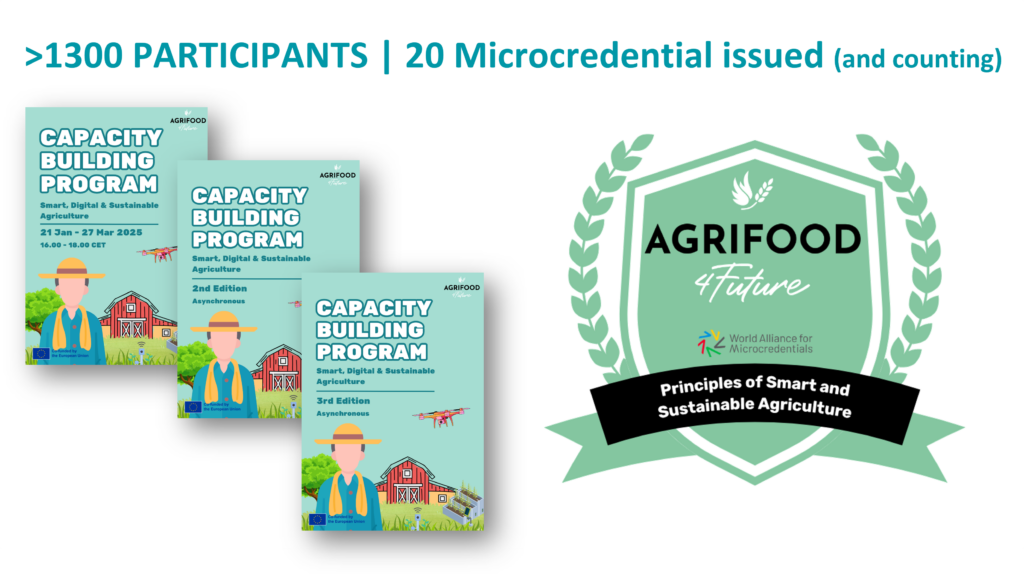
This is where AgriFood4Future becomes especially valuable. Through its Capacity Building and Technical Assistance programs, strengthening skills of more than 1300 participants from all around the globe, the project promotes smart farming, precision agriculture, climate-smart practices, regenerative approaches, and promotes new business models that improve efficiency and resilience. It also supports lifelong learning and micro-credentials, helping participants build the technical, entrepreneurial, and soft skills needed to adopt and scale new solutions. In practical terms, this can mean better farm management, lower input dependence, improved competitiveness, and reduced environmental pressure. That is how the sector can become more efficient, more climate-friendly, and better prepared for the future.
References
[1] https://pmc.ncbi.nlm.nih.gov/articles/PMC10859166/
[2] https://www.oecd.org/content/dam/oecd/en/publications/reports/2022/04/the-digitalisation-of-agriculture_dd2a1973/285cc27d-en.pdf
[3] https://www.frontiersin.org/journals/environmental-science/articles/10.3389/fenvs.2024.1375193/full
[4] https://pmc.ncbi.nlm.nih.gov/articles/PMC11049518/